

Karelian lament tradition and its new spiritual interpretations in Finland in 2020s
Funders

Leaders

Karelian lament tradition and its new spiritual interpretations in Finland in 2020s
The project examines the relationship between the lament tradition and vernacular religion/spirituality in contemporary Finland and reviews these in light of earlier research on the connection in 19th-century Karelian village communities. In these village communities, laments were integral to vernacular Eastern Orthodoxy and played a central role in certain rites, such as funerals and weddings. In present-day Finland, lamenting is linked to various religious and spiritual interpretations. These contemporary modes of vernacular religiousness, which combine elements from different religions and spiritual movements, are regarded as new spirituality. Overall, contemporary Finnish lamenting practices are diverse, ranging from the performing arts and folk music to therapeutic interpretations. or connecting ones Karelian family roots and reclaiming Karelian heritage (see, for example, the project Kyynelkanavat – Lametns in contemporary Finland).
In this project, I ask: How have present conceptions of laments diverged from the traditional religious meanings of the Karelian village community of the late 19th and early 20th centuries, where elements of folk religion and Orthodoxy are interwoven? What kinds of meanings and practices have taken their place? This research lies at the intersection of folkloristics and religious studies and complements my previous research, in which I have analysed the diversity of lamenting practices in contemporary Finland, with a particular focus on folk music, the performing arts, and cultural ownership. The material for this study consists of ethnographic interviews and media sources. I use discourse analysis.
This research draws on two intertwined theoretical frameworks: decolonisation and therapeutic culture. Decolonisation concerns the relations between Finnish and Karelian cultures and identities; how the tradition of the Karelian-speaking minority has been freely taken and shaped for the use of the Finnish majority and what opportunities Karelian-speaking people have to maintain and develop their culture and language. Eva Illouz’s concept of therapeutic culture, on the other hand, refers to the mundaneisation of psychological thinking and emotional speech, and is also associated with broader neoliberal ideas of individual responsibility. The concept of therapeutic culture is suitable for the study of contemporary interpretations of lamenting, since many emphasise the psychological and emotional well-being-promoting effects of lamenting. My research is also influenced by critical heritage studies.
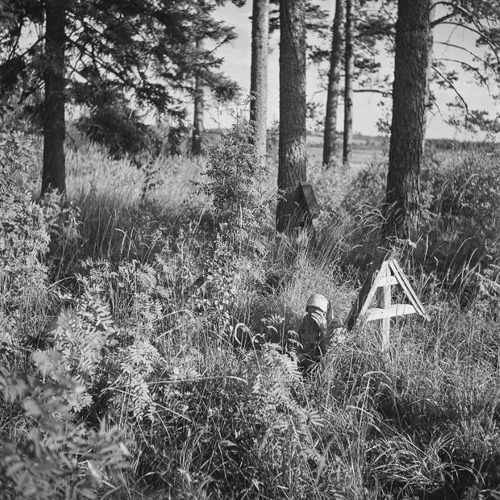
Photo: Eino Mäkinen, 1936, Salmi, Karelia. Finnish Heritage Agency.
The project is funded by Alfred Kordelin Foundation.