

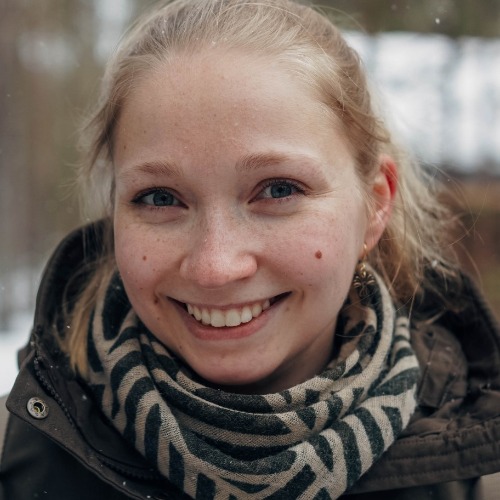
Mariana Verdonen
Grant-funded Researcher
PhD, Physical Geography and Remote Sensing
Department of Geographical and Historical Studies, Faculty of Social Sciences and Business Studies

I am a physical geographer specialising in remote sensing and GIS, with substantial experience of working in multi- and interdisciplinary projects across a variety of (sub-)Arctic field locations. My scientific interests include periglacial geomorphology, permafrost–landscape dynamics, the impacts of climate change on tundra ecosystems, Arctic socio-ecological systems, and the remote sensing of the cryosphere.
Research groups
Research Projects
-
Postdoctoral research project funded by the Maj and Tor Nessling foundation.
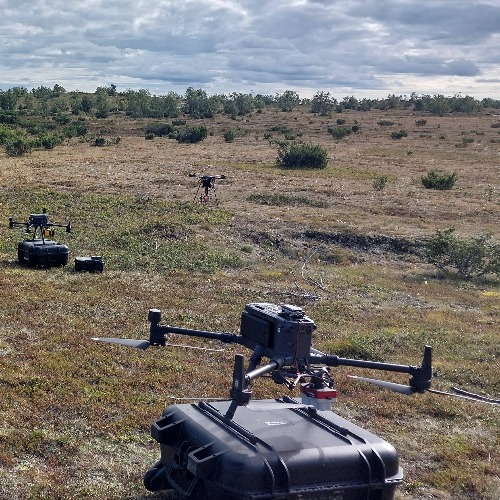
This research advances sustainability transformation by adding knowledge about permafrost and its connections to climate change. The project uses a unique combination of multi-sensor remote sensing and field data to study palsa mire dynamics. Due to climate change, these subarctic carbon stores and biodiversity hotspots are among the most threatened habitats in Europe. Their degradation contributes to greenhouse gas emissions, hydrological and ecological shifts, and reduced ecosystem services. A better understanding of how palsa mires in different environments respond to climate forcing is crucial for their effective protection. By developing a monitoring framework and identifying both vulnerable and resilient palsa mire areas, the project generates actionable knowledge to support early detection of permafrost degradation and to inform conservation and climate strategies. Strong emphasis is placed on long-term monitoring, international collaboration, and diverse communication.
-
Pilot study funded by the Landsvirkjun Energy Research Fund
Palsa mires (rústamýrar) are among the most threatened habitats in Iceland due to climate change. However, little is known about the current state of palsa mires in Iceland, their biota, rate of change and its relation to local climate, or the implications of permafrost thaw on the surrounding ecosystem and watershed. While general patterns of palsa degradation are documented in other regions, there is a lack of detailed, long-term studies specifically focusing on the extent and rate of permafrost degradation in Icelandic palsa mires, which are affected by volcanic soils and aeolian dust deposition. Although the degradation of these landforms is evident, it remains unclear how responsive different palsa mires are. To address the lack of knowledge about the current state of Icelandic palsa mires and to promote long-term monitoring, our interdisciplinary project has brought together experts in physical geography, remote sensing, soil science, and terrestrial and freshwater ecology.
-
My PhD research, in which I investigated permafrost-landscape changes in Yamal Peninsula, Northern Russia, and in Finnish Lapland.
A short summary of the key findings and methods used is provided in the dissertation news release: The new insights into periglacial landscape dynamics
Networks and Collaborations
-
The biome boundary between the boreal forest and tundra is rapidly shifting due to ongoing climate warming and changes in land use. As a result, many species typical of the forest are expanding into the tundra, a process known as borealization. These shifts in the forest-tundra biome boundary will have important consequences for the functioning of terrestrial Nordic ecosystems and ultimately, for their ability to provide valuable ecosystem services.
The Nordic Borealization Network (NordBorN) is a five-year project funded by NordForsk that has established a collaboration platform across the Nordic countries to understand the implications of borealization in Nordic terrestrial ecosystems. The aim of NordBorN is two-fold: 1) to create a venue for research excellence in terrestrial ecology to understand the processes, drivers and consequences of borealization of Nordic ecosystems, and 2) to establish a training hub for the next generation of Nordic researchers.
To achieve this goal, NordBorN brings together six Nordic universities and three associated partners, including 27 participants in different career stages and with complementary expertise, who collaborate on research projects, jointly develop research funding applications and create opportunities for mobility and co-supervision of graduate students across Nordic universities.
Publications:
Verdonen, M., Barrio, I. C., Barbero-Palacios, L., López-Blanco, E., Speed, J. D. M., Defourneaux, M., García Criado, M., Moullec, M. le, Mellard, J. P., Salazar, A., Bakke Westergaard, K., Guðmundsson, J., Schmidt, N. M., Sigurdsson, B. D., Austrheim, G., Bjorkman, A. D., Björnsdóttir, K., Jepsen, J. U., Pagneux, E. P., Trascau, B.M., Williamson, D.R., Aradóttir, Á.L., Barry, A., Bernard, T., Koivisto, E., Kumpula, T., Villoslada, M. & Myers-Smith, I. H. (2026) Borealization of tundra ecosystems with climate and land-use change. Environmental Research Letters, 21(1):013002, https://doi.org/10.1088/1748-9326/ae2e18
-
Publications
12/12 items-
Abrupt Thaw in a Finnish Palsa: Potential CH4 Production Driven by Vegetation Adaptation in the Transition From Permafrost to Post-Thaw Soils
Baysinger, M R; Laurent, M; Verdonen, M; Reif, J; Kumpula, T; Liebner, S; Treat, C C, 2025, Journal of geophysical research : biogeosciences, 130, 9, e2025JG008847. A1 Journal article (refereed), original research -
Interannual spectral consistency and spatial uncertainties in UAV-based detection of boreal and subarctic mire plant communities
Wolff, Franziska; Kolari, Tiina H. M.; Räsänen, Aleksi; Tahvanainen, Teemu; Korpelainen, Pasi; Villoslada, Miguel; Verdonen, Mariana; Lotsari, Eliisa; Pang, Yuwen; Kumpula, Timo, 2025, Remote sensing in ecology and conservation, 11, 6, 719-739. A1 Journal article (refereed), original research -
Periglacial landscape dynamics: coupled analysis of a changing Arctic using remote sensing and field observations
Verdonen, Mariana, 2024, Publications of the University of Eastern Finland : dissertations in social sciences and business studies. G5 Doctoral dissertation (article) -
Socioecological dynamics of diverse global permafrost-agroecosystems under environmental change
Ward Jones, Melissa; Habeck, Joachim Otto; Ulrich, Mathias; Crate, Susan; Gannon, Glenna; Schwoerer, Tobias; Jones, Benjamin; Kanevskiy, Mikhail; Baral, Prashant; Maharjan, Amina; Steiner, Jakob; Spring, Andrew; Price, Mindy Jewell; Bysouth, David; Forbes, Bruce C; Verdonen, Mariana; Kumpula, Timo; Strauss, Jens; Windirsch, Torben; Poeplau, Christopher; Shur, Yuri; Gaglioti, Benjamin; Parlato, Nicholas; Tao, Fulu; Turetsky, Merritt; Grand, Stephanie; Unc, Adrian; Borchard, Nils, 2024, Arctic antarctic and alpine research, 56, 1, 2356067. A1 Journal article (refereed), original research -
Spatial Distribution of Thaw Depth in Palsas Estimated From Optical Unoccupied Aerial Systems Data
Verdonen, Mariana; Villoslada, Miguel; Kolari, Tiina H M; Tahvanainen, Teemu; Korpelainen, Pasi; Tarolli, Paolo; Kumpula, Timo, 2024, Permafrost and periglacial processes, 36, 1, 22-36. A1 Journal article (refereed), original research -
Permafrost degradation at two monitored palsa mires in north-west Finland
Verdonen, Mariana; Störmer, Alexander; Lotsari, Eliisa; Korpelainen, Pasi; Burkhard, Benjamin; Colpaert, Alfred; Kumpula, Timo, 2023, Cryosphere, 17, 5, 1803-1819. A1 Journal article (refereed), original research -
Coping with a Warming Winter Climate in Arctic Russia: Patterns of Extreme Weather Affecting Nenets Reindeer Nomadism
Forbes, Bruce C; Kumpula, Timo; Meschtyb, Nina; Laptander, Roza; Macias-Fauria, Marc; Zetterberg, Pentti; Verdonen, Mariana; Skarin, Anna; Kim, Kwang-Yul; Boisvert, Linette N; Stroeve, Julienne C; Bartsch, Annett, 2022, Roué, Marie; Nakashima, Douglas; Krupnik, Igor , Resilience Through Knowledge Co-Production : Indigenous Knowledge, Science and Global Environmental Change, 217-232. A3 Book section, Chapters in research books -
Periglacial vegetation dynamics in Arctic Russia: decadal analysis of tundra regeneration on landslides with time series satellite imagery
Verdonen, Mariana; Berner, Logan T; Forbes, Bruce C; Kumpula, Timo, 2020, Environmental research letters, 15, 10, 105020. A1 Journal article (refereed), original research -
Recent trends and remaining challenges for optical remote sensing of Arctic tundra vegetation: A review and outlook
Beamish, A; Raynolds, M K; Epstein, H; Frost, G V; Macander, M J; Bergstedt, H; Bartsch, A; Kruse, S; Miles, V; Tanis, C M; Heim, B; Fuchs, M; Chabrillat, S; Shevtsova, I; Verdonen, M; Wagner, J, 2020, Remote sensing of environment, 246, 111872. A2 Review article, Literature review, Systematic review -
Reindeer use of low Arctic tundra correlates with landscape structure
Skarin, Anna; Verdonen, Mariana; Kumpula, Timo; Macias-Fauria, Marc; Alam, Moudud; Kerby, Jeffrey; Forbes, Bruce C, 2020, Environmental research letters, 15, 11, 115012. A1 Journal article (refereed), original research